MAGIC – Major Atmospheric Gamma Imaging Cherenkov Telescope
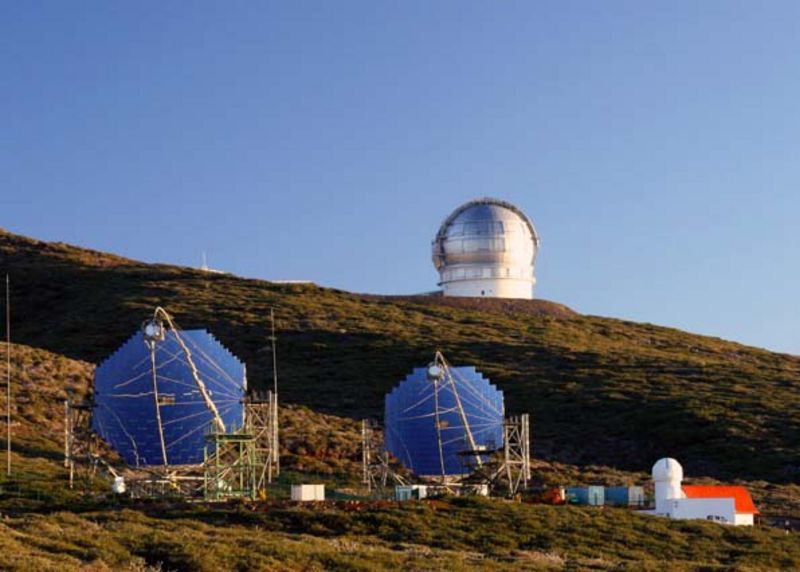
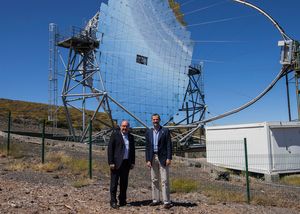
With a reflector diameter of 17 meters each, the two MAGIC telescopes are the most sensitive Cherenkov telescopes in the world, especially in the energy range below 200 gigaelectronvolts (GeV). Their line of sight is directed at objects that emit gamma rays ranging from 30 GeV to 100 TeV (teraelectronvolts). This means that MAGIC can cover an enormous energy spectrum.
The twin telescopes are located 2,200 meters above sea level on the Canary Island of La Palma where the clear skies and lack of light pollution make for optimal observing conditions. The Max Planck Institute for Physics (MPP) leads the international collaboration of about 165 astrophysicists from 24 research institutions in eleven countries. Together, they are responsible for the construction, operation and maintenance of the telescopes. MAGIC allows astrophysicists to obtain first class data for gaining scientific insights into enigmatic objects and the most violent processes in the universe.
The MAGIC telescopes have been in operation since 2003 and 2009 respectively. The MPP played a major role in the development and construction of their mechanical structure, imaging cameras and calibration system.
Since the outset, MAGIC has delivered many valuable scientific discoveries.
MAGIC at the MPP
Extremely energetic photons from the Crab Pulsar are discovered — Observations outshine previous measurements
The most energetic light ever observed from a few kilometres large star
Phone number: +49 89 32354-extension
| name | function | extension | office | |
|---|---|---|---|---|
| Arbet-Engels, Axel, Dr. | Postdoc | aarbet | 289 | A.2.38 |
| Bautista Sierra, Angela Yulieth | Student | bautista | 312 | A.2.52 |
| Berti, Alessio | Postdoc | aberti | 227 | A.2.50 |
| Besenrieder, Jürgen | Engineering | jhose | 224 | A.1.45 |
| Ceribella, Giovanni, Dr. | Postdoc | ceribell | 291 | A.1.61 |
| Chon, Gayoung | Visiting Scientist | gchon | 328 | A.1.23 |
| Gaborit-Reitz, Lucas | Student | lucasgr | 312 | A.1.23 |
| Green, David, Dr. | Postdoc | damgreen | 289 | A.2.54 |
| Green, Jarred Gershon | PhD Student | jgreen | 259 | A.2.44 |
| Hahn, Alexander | PhD Student | ahahn | 421 | A.2.46 |
| Heckmann, Lea | PhD Student | heckmann | 259 | A.2.44 |
| Jimenez Martinez, Irene, Dr. | Postdoc | irenejm | 364 | A.1.47 |
| Mirzoyan, Razmik, Dr. | Senior Scientist | razmik | 328 | A.2.34 |
| Nozaki, Seiya, Dr. | Postdoc | nozaki | 227 | A.2.50 |
| Oswald-Kloi, Melanie | Secretary | moswald | 364 | A.2.43 |
| Paneque, David, Dr. | Senior Scientist | dpaneque | 349 | A.2.36 |
| Peresano, Michele, Dr. | Postdoc | peresano | 543 | A.1.47 |
| Pirola, Giorgio | PhD Student | gpirola | 259 | A.2.44 |
| Scherpenberg, Juliane van | PhD Student | jvsch | 421 | A.2.46 |
| Schmuckermaier, Felix | PhD Student | fschmuck | 485 | A.2.46 |
| Schweizer, Thomas, Dr. | Senior Scientist | tschweiz | 291 | A.2.32 |
| Strom, Derek, Dr. | Engineering | dstrom | 422 | B.2.11 |
| Teshima, Masahiro, Dr. | Director | mteshima | 301 | A.2.41 |
| Wang, Yunhe | Student | yunhe | 312 | A.2.52 |
| Werner, Diana | Secretary | dwerner | 364 | A.2.43 |
| Will, Martin, Dr. | Postdoc | mwill | 291 | A.1.61 |
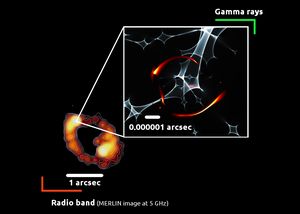
Detection of very high energy gamma-ray emission from the gravitationally-lensed blazar QSO B0218+357 with the MAGIC telescopes
MAGIC Collaboration
arxiv:1609.01095
Teraelectronvolt pulsed emission from the Crab Pulsar detected by MAGIC
MAGIC Collaboration
Astronomy & Astrophysics, Volume 585 (January 2016)
doi:10.1051/0004-6361/201526853
Very high Energy γ-Ray from the universe’s middle age: Detection of the z = 0.940 Blazar PKS 1441+25 with MAGIC
Magic Collaboration
The Astrophysical Journal Letters, 815:L23 (8pp), 2015 December 20
doi:10.1088/2041-8205/815/2L23