News

Karoline Schäffner honored in the Lise Meitner Excellence Program

Karoline Schäffner has been awarded one of the coveted Lise Meitner positions at the Max Planck Society. The Lise Meitner Excellence Program now opens up long-term prospects for Karoline Schäffner and her field of research at the MPI for Physics. The…

Read more
[Translate to English:]

Cosmic inflation with standard particle physics repertoire

How did the universe come into being? There are a multitude of theories on this subject. In a recent paper, three scientists formulate a new model: according to this, inflation, the first, very rapid expansion of the universe, would have taken place…

Read more
The image shows a representation of the cosmic microwave background, a kind of echo of the Big Bang. It is an oval with different colored dots. These show that there were fluctuations in temperature and energy densities in the universe from the beginning, from which the large-scale structures in the universe later emerged (Image: ESA/Planck Collaboration)

The origin of the universe: Looking back to the beginning

Humans have always been fascinated with the question of how the world came into being. Since the early universe cannot be observed directly, there are currently only theories and speculations about the first moments of the Big Bang and the further…

Read more
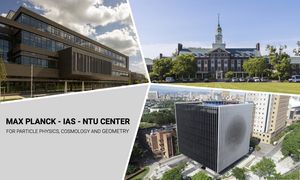
Signing the contract for the new Max Planck Center (from left): Yu-tin Huang (NTU, deputy co-Director), Daniel Baumann (NTU, co-director), Wen-Chang Chen (President of NTU), Claudia Felser (Vice President of MPG), Johannes Henn (MPP, co-director), and Matias Zaldarriaga (IAS, deputy co-Director); Photo: Tsu-Ying Chiang

New Max Planck Center for Particle Physics, Cosmology, and Geometry inaugurated

On 1 September 2025, the Max Planck Society, the Institute for Advanced Study (Princeton, USA), and National Taiwan University (Taipei, Taiwan) officially opened the Max Planck–IAS–NTU Center for Particle Physics, Cosmology, and Geometry in Taipei.…

Read more

Uncertainty – from Heisenberg to quantum field theory

Café & Kosmos on October 21, 2025

Café & Kosmos on October 21, 2025

100 years ago, physicists such as Heisenberg, Schrödinger, and Born fundamentally revolutionized our understanding of physics with the establishment of quantum mechanics. Although the quantum world often contradicts…

Read more
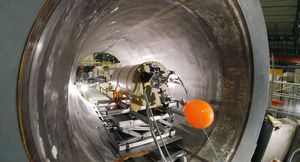
The MADMAX booster inside CERN’s MORPURGO magnet

Axion search: crucial progress in the MADMAX experiment

The axion has the potential to solve two of the most pressing open questions in particle physics: the dark matter could be composed of axions, and axions could resolve a mystery in our understanding of the strong nuclear force. MADMAX, an…

Read more
Collisions in the ATLAS experiment can produce two jets. This type of event formed the basis for the current study. (Image: ATLAS/CERN)

Theory of strong interaction: Current studies confirm previous predictions

The strong interaction is one of the four fundamental forces in the universe. Around 50 years after it was first described, its theoretical foundations have now been tested with unprecedented accuracy in two recent studies. Scientists from the Max…

Read more
The new Max Planck – IAS – NTU Center: Max Planck Institute for Physics, Institute for Advanced Study (IAS), National Taiwan University (clockwise; photos: Massimo Fiorito (MPP), Dan Komoda (IAS) and NTU)

New Max Planck Center for Particle Physics, Cosmology and Geometry

A Rosetta Stone for understanding the Universe at all scales
The theories researchers use to describe the Universe at small and large scales – from the Standard Model of particle physics to general relativity—have proven incredibly successful. Yet, such theories remain incompatible with one another and carry…

Read more
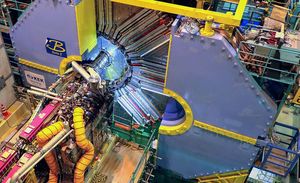
B mesons (pairs of b quarks) and their antiparticles are produced during particle collisions in the Belle II detector. The experiment aims to find out why there is an excess of matter in the universe (Photo: Shoto Takahashi - KEK/Belle II)

Quantum entanglement: do elementary particles have telepathic abilities?

Café & Kosmos on July 30, 2025
Café & Kosmos on July 30, 2025

Read more

European Strategy for Particle Physics: German community meets at MPP

On April 28 and 29, 2025 a meeting of the German particle physics community will take place at the Max Planck Institute for Physics. The workshop is part of the decision-making process for the long-term European strategy in particle physics. The…

Read more